
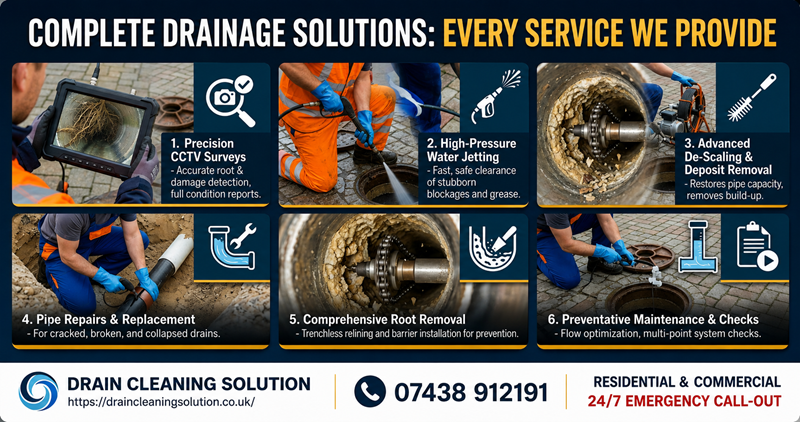
If you have ever stood over a kitchen sink that refuses to drain, or discovered that your outdoor inspection chamber is brimming with waste water, you will know the particular misery of a blocked drain in South London. The question most people ask next is a simple one: what is the fastest, most reliable way to clear it and stop it happening again? The answer, in almost every case, is high-pressure drain jetting and in this guide, we explain exactly why.
South London’s drainage infrastructure is one of the most challenging in the country. Properties across Croydon, Sutton, Mitcham, Bromley, Streatham, and Norbury sit above a network of clay pipes laid between 80 and 140 years ago. These pipes are narrow, jointed, and increasingly fragile. They accumulate grease, scale, debris, and root matter at a rate that no chemical cleaner or drain rod can adequately address. Drain jetting in South London is the professional solution and understanding how it works will help you make informed decisions the next time your drainage system lets you down.
What Is High-Pressure Drain Jetting?
High-pressure drain jetting also called hydro jetting or power jetting is a method of clearing and cleaning drainage pipes using a concentrated stream of water delivered at very high pressure. A flexible hose is inserted into the drain through an access point, such as an inspection chamber or manhole, and pushed along the pipe while water is discharged at pressures of up to 4,000 PSI (pounds per square inch) from a specialised nozzle at the head.
The jetting head cuts through accumulated grease, scale, tree root material, compacted silt, and debris that ordinary rodding or chemical treatments cannot shift. Unlike a drain rod, which punches a hole through a blockage but leaves the bulk of the obstruction in the pipe, jetting removes the material entirely, flushing it forward through the drain run and restoring the full bore of the pipe.
Professional drainage engineers deploy jetting rigs that deliver significantly greater pressure and flow than any domestic pressure washer. The combination of pressure, flow rate, and the design of the jetting nozzle which simultaneously cuts forward and pulls the hose through the pipe makes it effective against even the most stubborn long-standing blockages.
Why Blocked Drains in South London Need More Than a Plunger
The typical blocked drain in South London has not developed overnight. The drainage problems that present as an immediate crisis a completely backed-up toilet, water flooding across a kitchen floor, sewage smell permeating a ground-floor room are usually the final stage of a process that has been building for months or years.
South London’s older housing stock creates specific conditions that accelerate drain blockage:
- Grease accumulation: In the dense residential and commercial areas of South London, cooking oils and fats enter the drainage system continuously. As they cool, they adhere to pipe walls, creating an ever-thickening layer that progressively narrows the bore.
- Tree root intrusion: The mature trees that characterise South London’s residential streets have root systems that infiltrate clay pipe joints over decades, creating root masses that trap debris and eventually block the pipe entirely.
- Silt and scale: Minerals in London’s hard water supply deposit scale on pipe walls over time, and silt carried by rainwater entering drainage systems accumulates at low points and bends in the pipe run.
- Collapsed joints: Ground movement on London Clay causes pipe joints to shift and step, creating ledges that trap debris even after a basic clearance.
A plunger cannot address any of these causes. A drain rod might shift a surface obstruction but leaves the underlying accumulation in place. Chemical drain cleaners are corrosive and, on South London’s ageing clay pipes, can do more long-term damage than good. High-pressure jetting addresses all of these problems directly.
The Professional Drain Jetting Process: What to Expect
When you engage a professional drain unblocking service in South London, the process typically begins with a visual assessment of the accessible drain points inspection chambers, external gullies, and internal rodding eyes. This assessment tells the engineer which section of the drainage system is likely to contain the blockage and determines the best access point for the jetting equipment.
- The jetting hose is inserted through the chosen access point and pushed towards the blockage.
- Water is discharged at high pressure, cutting through the obstruction and flushing debris along the pipe towards the sewer.
- The engineer monitors progress and works the jetting head backward along the pipe, cleaning the pipe walls of accumulated scale and grease as they withdraw.
- Once the drain is clear, flow is tested from fixtures inside the property to confirm drainage has been fully restored.
- For persistent or recurring blockages, a CCTV drain survey is recommended after jetting to confirm the pipe is fully clear and to identify any structural issues that may have contributed to the blockage.
Why Choose a Specialist Drain Cleaning Company?
Not all drainage contractors approach drain jetting in South London with the same level of care and equipment. A true specialist drain cleaning company will carry professional-grade jetting equipment capable of generating sufficient pressure and flow rate to clean South London’s older, narrower clay pipes effectively. They will also carry CCTV inspection equipment, so they can confirm the result of the jetting and identify any structural issues that need attention.
The distinction matters because a jetting contractor who clears a blockage without confirming the pipe’s structural condition may leave you with a temporarily clear drain that blocks again within weeks because the underlying root intrusion, displaced joint, or partial collapse that created the blockage in the first place has not been identified or addressed.
A specialist company treats the jetting clearance as the first step in a full assessment, not the only step.
How Drain Jetting Differs From Emergency Drain Unblocking
There is sometimes confusion between a standard drain unblocking service in South London and a full drain jetting clean. In practice, the two overlap significantly: most professional drain clearances in South London use high-pressure jetting as the primary method. The term ‘drain jetting’ tends to be used when the emphasis is on thoroughly cleaning the pipe removing years of scale and grease accumulation rather than simply clearing an immediate obstruction.
For a drain that is blocked and causing an immediate problem, jetting clears it. For a drain that has been repeatedly blocking, or one that a CCTV survey has shown to be heavily scaled or partially restricted, a full jetting clean restores it to as-new flow capacity. Many drainage contractors will carry out both in the same visit.
| How often should South London drains be jetted? For domestic properties with no known issues, a high-pressure drain clean every two to three years is a reasonable preventative measure. For properties with a history of recurring blockages, annual jetting combined with a CCTV inspection prevents the accumulation that leads to emergency callouts. |
Drain Jetting for Commercial Properties in South London
Commercial properties across South London restaurants, takeaways, offices, retail units, and industrial premises carry significantly higher drainage loads than residential properties. For food businesses in particular, the rate of grease entry into the drainage system is high, and without regular professional jetting, a complete blockage is typically a matter of months rather than years.
We carry out commercial drain jetting across South London on a reactive emergency basis and as part of planned preventative maintenance programmes. A regular drain maintenance contract eliminates the risk of an unexpected blockage during a busy service period and keeps commercial drainage systems compliant with environmental and health standards.
Frequently Asked Questions
How quickly can you respond to a blocked drain in South London?
In most cases, we aim to have an engineer on site within one to two hours of your call. For genuine drain emergencies sewage backup, flooding we treat your callout as an absolute priority and aim to respond as quickly as possible.
Is drain jetting safe for older clay pipes?
Yes, when carried out correctly by an experienced engineer. We adjust pressure settings based on the age and condition of the pipe, ensuring effective cleaning without risk of damage. A CCTV survey beforehand lets us assess the pipe condition before any jetting begins.
Will jetting fix a drain that keeps blocking?
Jetting will clear the current blockage. If the drain has been blocking repeatedly, there is likely a structural reason root intrusion, a cracked pipe, a displaced joint that needs to be addressed separately. A CCTV survey after jetting will identify this and allow us to recommend the appropriate repair.
| Blocked Drain in South London? Call Our Jetting Team
Available 24/7 · Professional jetting rigs · No call-out fee · Engineers across South London 07438 912191 |
