
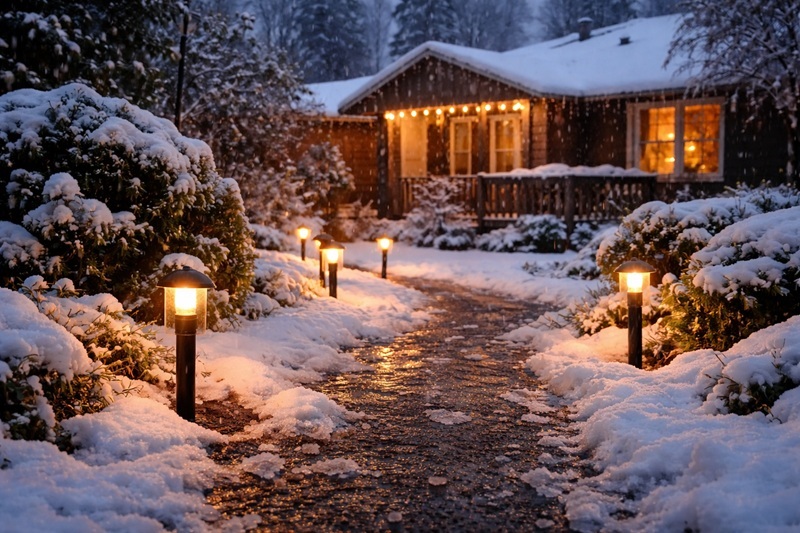
Every fall, homeowners across Marysville do the same thing. They head to the hardware store, pick up a set of solar pathway lights or a string of weatherproof stake fixtures, spend a Saturday afternoon setting everything up, and feel pretty good about the results. The yard looks great. The walkway is lit. The front of the house has that warm glow they were after.
Then November hits. The rain starts in earnest. Daylight shrinks to barely eight hours. And by December, half those lights are flickering, two have stopped working entirely, and the solar fixtures that looked so promising are putting out about as much light as a birthday candle.
This is not a rare experience in Marysville. It happens to a lot of homeowners every single year, from the newer subdivisions in Whiskey Ridge to the established neighborhoods in Sunnyside and Shoultes. The problem is not that homeowners are doing something wrong. The problem is that most consumer-grade outdoor lighting products are simply not built for what Pacific Northwest winters actually deliver.
The Marysville Winter Problem Is More Than Just Rain
Marysville sits in the northern Puget Sound region, and the climate here is unforgiving on outdoor electrical equipment. The city averages around 42 inches of rain per year, with the bulk of it falling between October and March. Temperatures in winter routinely cycle just above and just below freezing, which means fixtures, wiring connections, and housing seals are constantly expanding and contracting. That constant stress is exactly what cheap materials cannot handle.
Add in the clay-heavy soils common throughout much of Marysville, particularly around Jennings Park and parts of Cedarcrest, and you have a second major issue: waterlogging. When clay soil becomes saturated, water has nowhere to go. Buried wiring that is not properly conduit-protected sits in water for weeks at a time. Low-quality insulation degrades. Connections corrode. Fixtures installed directly in soggy ground develop moisture intrusion at the base, which short-circuits the lighting system from the bottom up.
Then there is the light issue. Solar-powered landscape lighting depends on peak sun hours to charge adequately. In Marysville, December and January typically deliver fewer than two hours of peak solar radiation per day. That is not enough to charge most consumer solar fixtures to full capacity. The result is dim, inconsistent output that fades within an hour or two of sunset, which is precisely when you actually need the lighting to work.
Why Most DIY Outdoor Lighting Fails in the Pacific Northwest
There are three consistent failure points that show up in DIY outdoor lighting installations throughout Marysville, regardless of what product the homeowner used:
1. Solar Fixtures Were Designed for Sunnier Climates
Most solar outdoor lighting products are tested and rated for performance in climates that average four to six peak sun hours per day. Marysville gets roughly half that during winter months. What the product label promises and what actually happens in a Sunnyside backyard in January are two very different things. Solar pathway lights that work fine in Phoenix or even Seattle’s south end simply cannot keep up with the energy demands of a Marysville winter without the sun to back them up.
2. IP Ratings Are Not All Created Equal
You have probably seen the term “weatherproof” or “weather-resistant” on outdoor lighting packaging. What most homeowners do not realize is that these labels cover a wide range of actual protection levels. An IP44-rated fixture can handle splashing water from most directions. An IP65-rated fixture is fully sealed against low-pressure water jets from any direction. An IP67 fixture can be briefly submerged.
Box-store outdoor lighting typically falls in the IP44 range. That is fine for light summer showers. It is not adequate for the prolonged, driving rain that Marysville gets from November through February, or for the constant moisture exposure that comes with being planted in saturated soil near Smokey Point developments or the lower-lying areas around Kellogg Village. Moisture finds every imperfection in lower-rated fixtures, and the corrosion that follows is not reversible.
3. Surface-Laid and Shallow-Buried Wiring Fails Fast
Many DIY low-voltage landscape lighting kits include thin wire that is meant to be laid on the soil surface or barely covered. In dry climates, this works reasonably well. In Marysville, that wire is submerged in standing water for months at a time. Connections corrode at the push-in connectors. The wire jacket degrades under prolonged moisture exposure. And when the ground freezes and thaws through the winter, the movement can actually break connections entirely. By spring, homeowners are often looking at a lighting system that needs to be completely replaced rather than simply repaired.
What Professional Outdoor Lighting in Marysville Actually Looks Like
The difference between a DIY outdoor lighting setup and a professionally installed landscape lighting system is not just about aesthetics, though the visual difference is usually dramatic. It is about using the right materials, the right wiring methods, and the right fixture ratings for the actual conditions on the ground in Marysville.
Here is what a properly designed exterior lighting system for a Marysville home includes:
- IP65 or higher rated fixtures designed for full exposure to rain, moisture, and temperature swings. Not just splash-resistant, but genuinely sealed against prolonged wet conditions.
- Low-voltage LED systems powered by a hardwired transformer rather than solar panels. These deliver consistent, bright output every night regardless of how little sun Marysville saw that day.
- Properly conduit-protected buried wiring routed at code-required depth, keeping connections and conductors out of standing water.
- Corrosion-resistant fixture materials including brass, copper, and powder-coated cast aluminum that hold up to the salt-tinged air and constant moisture that the Puget Sound region delivers.
- Smart controls and timers that automatically adjust for seasonal changes in sunset time, so your landscape lighting in Marysville is always on exactly when you need it.
The Hidden Cost of Going the DIY Route
A set of 10 solar pathway lights might cost $60 to $100. That seems like a reasonable investment until you factor in that most Marysville homeowners replace these systems every two to three years because of the climate. Over a 10-year period, a homeowner in a neighborhood like Downtown Marysville or the Cedarcrest area can spend $300 to $600 on solar and box-store fixtures that never really work well in winter, add zero property value, and end up as plastic waste.
A professionally installed low-voltage LED landscape lighting system, by contrast, is designed to last 15 to 20 years with minimal maintenance. The fixtures hold up. The wiring stays sound. The system works every night. And real estate professionals consistently note that quality exterior lighting is one of the few curb appeal upgrades that adds visible, tangible value when a home is listed.
The math shifts pretty quickly when you stop replacing cheap fixtures every other year and start thinking about what a durable, properly installed system actually costs over time.
When Outdoor Lighting Requires a Licensed Electrician
Not every outdoor lighting project requires pulling a permit or hiring an electrician, but more of them do than most homeowners realize. In Marysville and throughout Snohomish County, any new circuit added to power an outdoor lighting transformer must be permitted and inspected. If your outdoor lighting plans involve floodlights, security lighting connected to your main panel, or a transformer that requires a dedicated circuit, you need a licensed electrician.
Beyond the permit question, there is the practical reality that outdoor wiring done incorrectly is a fire and shock hazard. Water and electricity are not forgiving when the installation is not done right. A licensed electrician knows the local soil conditions, understands Marysville’s permitting process through Snohomish County, and can design a system that will not just look good on installation day but will still be functioning reliably five, ten, and fifteen years from now.
Choosing the Right Outdoor Lighting System for Your Marysville Home
The best landscape lighting in Marysville is not the most expensive system. It is the right system for your property, your goals, and your climate. A few questions worth asking before you make any investment in outdoor lighting:
- Are you lighting for security, aesthetics, or both? The answer determines fixture type, placement, and brightness requirements.
- What is the soil composition in your yard? Clay-heavy areas near Jennings Park and Cedarcrest need different wiring strategies than sandier lots closer to Smokey Point.
- Does your current electrical panel have capacity for a new circuit? Older homes in Shoultes and Sunnyside may need a panel evaluation before adding hardwired outdoor lighting.
- Do you want smart controls? Dusk-to-dawn sensors and app-based scheduling are now standard options in professionally installed systems and make a noticeable difference in convenience and energy use.
A good electrician or outdoor lighting specialist can walk through these questions with you and design a system that fits your yard, your home’s architecture, and the specific way Marysville winters behave. The difference between that conversation and another trip to the hardware store is usually the difference between lighting that works and lighting that disappoints.
Stop Replacing Lights Every Winter
If your outdoor lighting has let you down once or twice already, it is worth having a professional take a look at what a properly designed system would cost for your property. A one-time investment in quality outdoor lighting in Marysville, installed correctly for the conditions here, will outperform years of box-store replacements and deliver the kind of curb appeal and security that actually holds up through a Pacific Northwest winter.
Our licensed electricians serve homeowners throughout Marysville, including Whiskey Ridge, Sunnyside, Jennings Park, Shoultes, and Smokey Point. We offer free on-site consultations and will give you a clear, upfront quote with no hidden charges.
Call us at (425) 760-3203 or schedule your free outdoor lighting consultation online. Let’s build a system that actually works all year long.
